
The world is getting hotter. Can paying people to protect forests help?
If you live in the UK, you’ve probably noticed this summer has been hot. Really hot.
A few years ago, these kinds of temperatures would have been unusual. Now they seem to come around every summer. And it’s not just the UK. Around the world we’re seeing more heatwaves, wildfires, floods and other extreme weather events. It is very likely that 2026 will be amongst the top five hottest years on record, continuing the trend of the ten most recent years being the ten hottest years on record.
So naturally, everyone is asking the same question: What can we actually do about it?
One answer is forests.
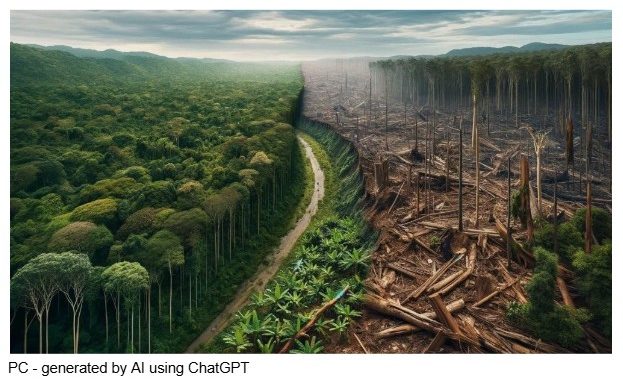
Forests absorb carbon dioxide, store enormous amounts of carbon, support biodiversity and help regulate our climate. The more forests we lose, the harder it becomes to slow climate change.
But here’s the challenge.
The same forces driving economic development—agriculture, mining, roads, urban expansion—are also putting forests under increasing pressure. Simply telling people to stop cutting down forests isn’t enough.
How about if there is an incentive to save forests!
That’s the idea behind REDD+ (Reducing Emissions from Deforestation and Forest Degradation, plus (+) means conservation and sustainable management of forests).
In simple terms, REDD+ tries to make standing forests more valuable than cleared forests. Countries and communities can receive financial incentives for protecting forests instead of losing them.
Sounds like a great idea.
But does it actually work?
Are forests really being protected? Who receives these payments? Are local and Indigenous communities benefiting? Is the system fair? And, perhaps most importantly, do we have good evidence that REDD+ is making a difference?
These are exactly the kinds of questions the UK Government wanted answered. The Research and Evaluation Centre (REC), looked at what the evidence already tells us.
Our first thought was to conduct a systematic review. But once we started digging into the literature, we found that there are already a lot of systematic reviews on REDD+.
So instead of starting from scratch, we stepped back and asked a different question:
What do all these systematic reviews tell us collectively?
That led us to conduct a scoping review of systematic reviews (sometimes called an umbrella review). The scoping review is accompanied by two evidence and gap maps – here and here – to help people navigate the evidence.
We identified 117 systematic reviews covering different aspects of REDD+. We found that there is a decent amount of research on how REDD+ works, its impact, how it is financed, and how carbon is priced. But it also showed some important gaps. For example, there is very little evidence comparing different REDD+ approaches, particularly project-based REDD+ and jurisdictional REDD+ (JREDD), making it difficult to know which works better under different conditions. Considerable efforts are now being made on developing systems to support JREDD. But it seems the evidence base on which they are doing so may be rather thin. But there are lessons to be learned from the experiences with project REDD+.
We also found limited research on whether the benefits of REDD+ are shared fairly, or how well projects address issues such as carbon leakage, additionality, and permanence. There is also less evidence on what local communities and other stakeholders think about REDD+, how prepared countries are to implement it, the role of Indigenous knowledge, and how benefits reach people on the ground. Although we did not comprehensively summarise these reviews, there clearly are concerns about those depending on forest livelihoods being displaced and not adequately compensated from REDD+ funds. The evidence for claimed co-benefits is weak.
And, surprisingly, forests with high tree cover but low rates of deforestation have received very little attention, even though protecting them could be just as important.
And even where there is evidence, a note of caution needs to be sounded.
There were plenty of systematic reviews, but many hadn’t followed well-established reporting and methodological standards such as PRISMA. That doesn’t necessarily mean their findings are wrong, but it does mean we should be a little more cautious about how much confidence we place in them.
Our review wasn’t about combining the results from these studies. Instead, we mapped what evidence already exists, where the evidence is strong, where it is weak, and where important knowledge gaps still remain.
If you work in climate change, forest conservation, evidence synthesis or climate finance, we hope you’ll find the report useful. Whether you’re planning new research, designing programmes or making investment decisions, it’s always helpful to know not just what we know, but also what we still don’t know.